A few years ago, I was given access to insightful, sometimes humorous, sometimes heartbreaking letters written by a Civil War soldier to his wife. She was my great-times-four Aunt Hester, and he was John Williamson, the son of Irish immigrants. At the start of the Civil War in April 1861 John was 22 years old, newly married to Hester, and working in a coal mine in northeastern Pennsylvania.
When the Union Army came to Eckley looking to recruit able-bodied young men, John signed up, like many of his friends. They were sent to training camp at Easton, 50 miles away, and then on to Washington, where they would take part in defending it from Confederate troops through the winter. From there, they would become involved in battles on the Virginia Peninsula.
In one of his earliest letters, John described their journey from Easton to Washington: “…On Friday morning we left Easton. We got into the cars about ten o’clock and didn’t get out of them till Saturday about nine o’clock…
He went on: “Dear Hester, all along the road to Harrisburg the country is very level and nice. We stopped a few minutes at Harrisburg but didn’t get out of the cars. It was night when we got into Harrisburg, and the same when we left it, so I can’t tell you anything about it. We slept in the cars that night…”
He continued:… “In the morning, when we got awake, we were in a different kind of country. We were on the borders of Dixie’s land. Maryland is very hilly and rough…”
I recently visited the train station at Hanover Junction in York County, Pennsylvania, which is located a few miles from the Maryland border. The station seems old and I wondered if it had been around during the Civil War. And if John had possibly passed through it on his way south.
A little research confirmed that Union troops coming from Harrisburg did pass through Hanover Junction. On the 1863 railroad map below, Easton is in the upper right, Harrisburg in middle left, and Hanover Junction in mid-lower left. The horizontal line below it is the Pennsylvania-Maryland border.
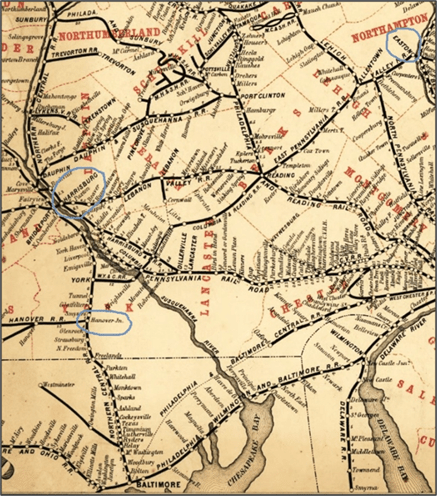
“New railway guide containing all the railroad in Pennsylvania…” 1863 (Library of Congress)
And yes, the train station at Hanover Junction was in existence during the Civil War, having been built between 1852 and 1854.
According to the website for Northern Central Railway: “…Hanover Junction played a large part in the Civil War. During the Battle of Gettysburg in 1863, both soldiers and supplies were transferred from the Northern Central Railroad to the Hanover Branch Railroad at Hanover Junction to complete the journey to Gettysburg. Wounded soldiers were evacuated from battlefields by rail to hospitals in both Harrisburg and Baltimore.
The Northern Central was a target of the Confederate forces during the summer of 1863, with the railroad bridge over the Codorus Creek in Hanover Junction being destroyed, along with the turntable located in the yard…”
Abraham Lincoln changed trains at Hanover Junction on his way to Gettysburg in 1863, and his funeral train passed by in April 1865.
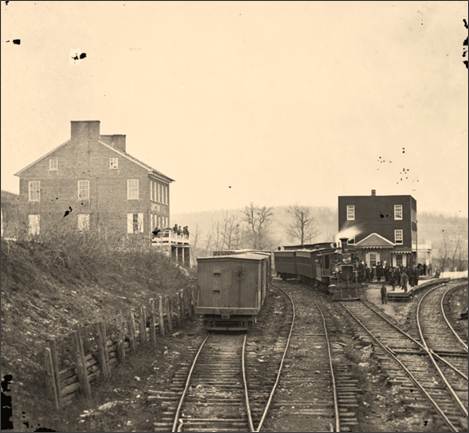
“Hanover Junction, Pa. Passenger train at depot,” 1863 (Library of Congress)
Based on what John said in his letter, he appears to have slept while his train car passed through Hanover Junction.
The train station at Hanover Junction gradually became dilapidated, but in 2003 underwent a major renovation. Northern Central Railway now operates excursion trains, steam and diesel, that come to and through Hanover Junction.

Hanover Junction, 2026
The station is beautifully renovated, with interesting history displays inside and a well-maintained rail trail that runs alongside the tracks.
Looking at it now, it’s hard to imagine the wounded soldiers, the Confederates burning the nearby bridge, and Lincoln’s funeral train going by the station.
And the young man, asleep in the rail car that passed by the station in the dark of night, who would never make it back home again.
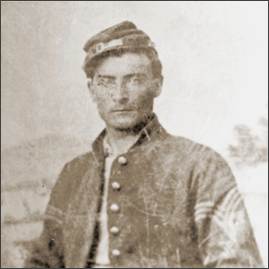
John Williamson
John Williamson’s letters form the core of the book “You Dream Every Night That I am Home,” found on Amazon.

