As I’ve admitted in previous posts, I’ve become fascinated with the idea of witness trees. And witness buildings, witness bridges, witness rail lines—anything and everything that’s borne witness to events, major and minor, in history.
The city of Fredericksburg, Virginia, established in 1728, is famous for its history. George Washington was 6 years old in 1738 when he and his family moved to nearby Ferry Farm, and in 1772 he bought a house for his mother in Fredericksburg, now known as the Mary Ball Washington House. There are historic buildings, what I think of as witness buildings, everywhere you look in downtown Fredericksburg.
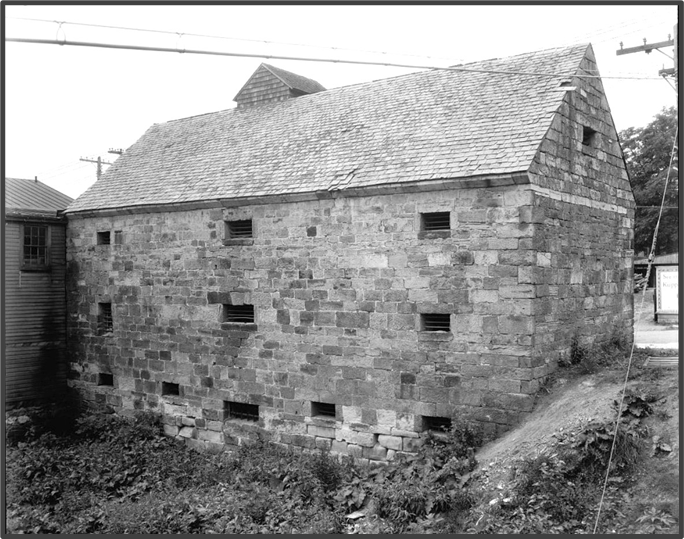
The building known as the Old Stone Warehouse, at the corner of William & Sophia Streets near Chatham Bridge was built in 1813. Over its long history it’s been used as a smokehouse for fish, a fertilizer plant, and a brewery.
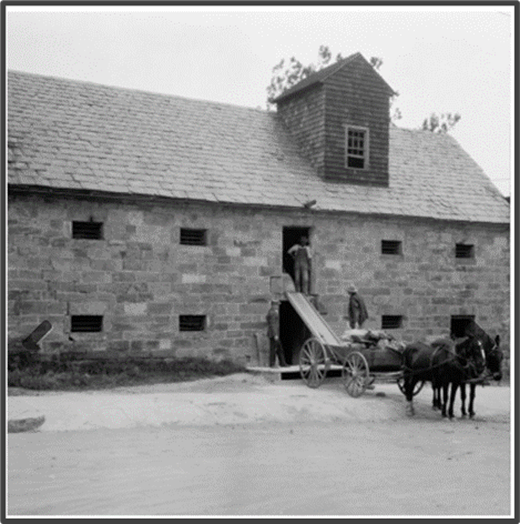
Built of sandstone blocks, the warehouse is 3 ½ stories in height, but you wouldn’t know that looking at it from Sophia Street. Originally, 2 ½ of those stories were visible from the road. The land drops down from the front to the rear of the building, where all its levels are exposed.
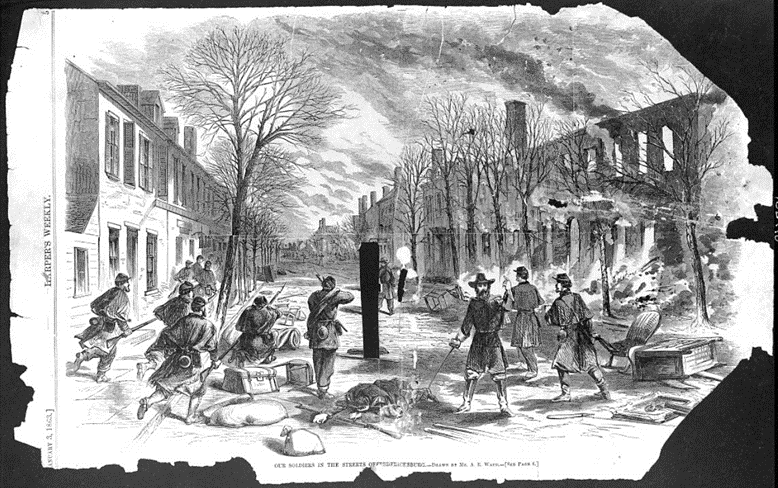
During the Civil War, the Battle of Fredericksburg occurred December 11-15, 1862 and was one of the largest and deadliest battles of the war.
Last year I published a book “You Dream Every Night That I am Home” based on the real letters of a Civil War soldier from Eckley, Pennsylvania. John Williamson was a sergeant in the Pennsylvania 81st Volunteer Infantry and fought on the Virginia Peninsula, including in some of the Seven Days Battles. He was killed at the Battle of Glendale on June 30, 1862.
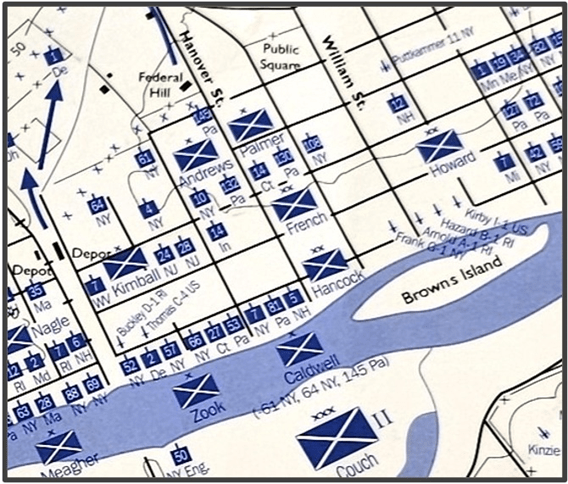
But the other men in the Pennsylvania 81st who’d survived the war so far were part of the troops who fought in Fredericksburg in December—John mentioned several of them in his letters. On the National Park Service map below, “81 PA” can be seen just above Caldwell, which is in the blue representing the river.
Below is a close-up of a bird’s-eye view map of Fredericksburg in November 1862. The ruins of a bridge are seen in the lower right corner of the image—this was a precursor to the current Chatham Bridge. The building just to the left of the end of it on the far shore is the Old Stone Warehouse. Two blocks to the left of the warehouse is Hanover Street, which is seen on the map above, with the PA 81st to the left of it.

The Old Stone Warehouse bore witness to the Battle of Fredericksburg—it has its own battle scars from being struck by cannonballs. It bore witness to all the men who came and fought—nearly 200,000 of them, including the men of the Pennsylvania 81st. And bore witness to those who died–the Old Stone Warehouse served as a military morgue: “…records indicate as many as 326 dead Union soldiers were housed [there]…”
When the Chatham Bridge was rebuilt in 1941, earth was piled up at the base of the front of the building to raise the level of Sophia Street, and another level of the Old Stone Warehouse disappeared from view.
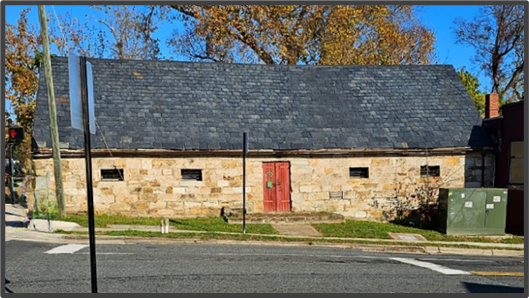
In its most recent incarnation, The Old Stone Warehouse was a private museum. It was closed in 2019 for reconstruction of the bridge and never reopened.
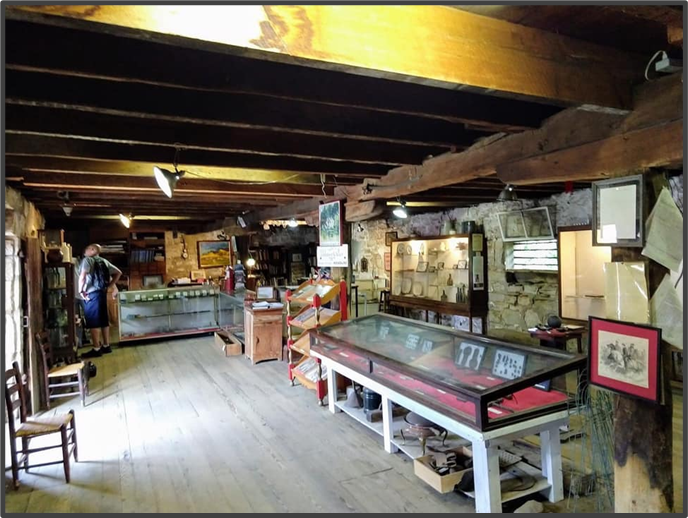
The Old Stone Warehouse has stood on the banks of the Rappahannock River for 210 years, surviving and witnessing war, reconstruction (of more than one kind), and the evolution of the city into a thriving tourist destination. I’ve heard that it might not reopen, and for those of us who never got a chance to see the inside of it for ourselves, that would be a pity. But given its solid appearance, it’s not hard to imagine it standing near Chatham Bridge for another 200 years, witnessing the events that will form the ongoing history of Fredericksburg.

 ChessieWriter