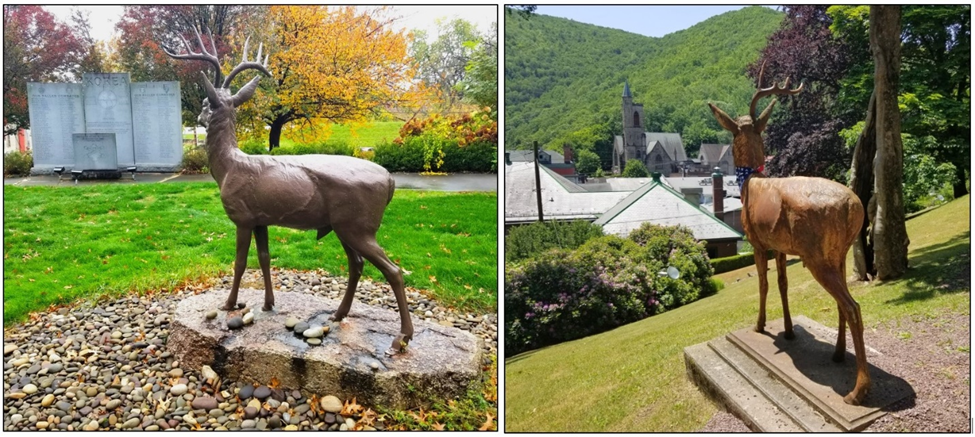
Their views are very different—one contemplates the Korean War Memorial on the Luzerne County courthouse grounds in Wilkes-Barre, Pennsylvania while the other, 37 miles south, gazes down at the town of Jim Thorpe from the front lawn of the Asa Packer Mansion.
They’re life-size, they’re made of cast iron, and they’re both well over a century old. One is known as the Court House Deer, and the other as Herbie the Elk.
The Court House Deer
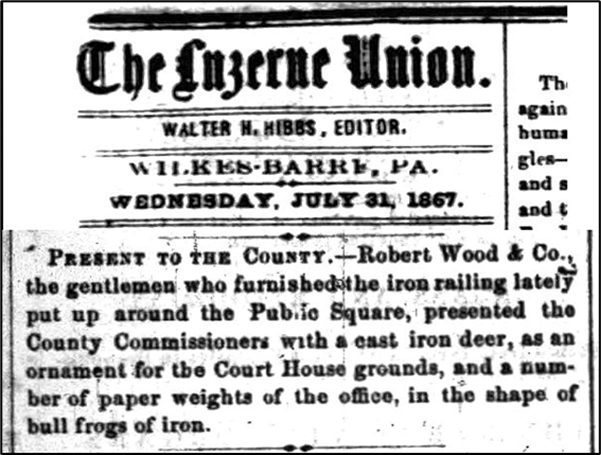
In the 1860s, the Luzerne County Courthouse was located in the Public Square in Wilkes-Barre. The Robert Wood & Company of Philadelphia, fabricator of ornamental ironworks, was hired to create an iron fence to surround the Public Square. Shortly thereafter, the company presented Luzerne County with a deer statue, as is seen in the newspaper article below:
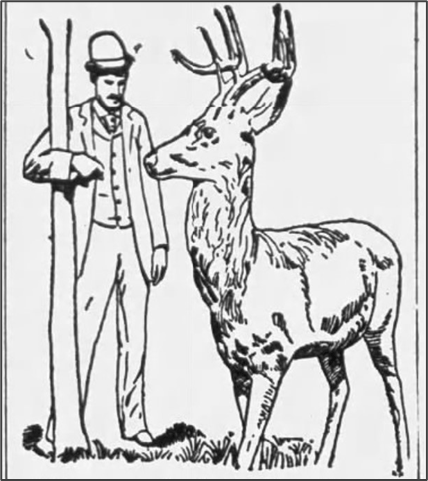
In 1888, a young reporter in Wilkes-Barre named Ernest Hanson started a newspaper column, writing articles in which he “interviewed” the Court House Deer. The Deer became famous, a local celebrity.
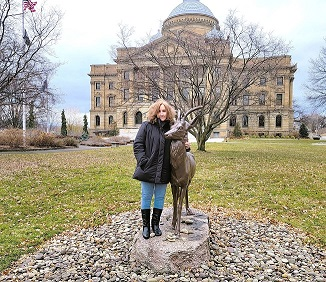
In 1909, the courthouse and its Deer were moved out of the Public Square to the River Common on the banks of the Susquehanna River. There they remain, and for generations it’s been popular to get a photo with the Deer on the courthouse lawn.
Last year I transcribed Hanson’s Court House Deer articles and put them into a book titled Conversations with the Court House Deer.
A couple of months ago, while doing more online research about the Court House Deer, I came across the mention of a deer statue at the Asa Packer Mansion. I was amazed that I’d never noticed it during my many visits to Jim Thorpe (my favorite getaway destination, known as “The Switzerland of America”). After Googling images of the Asa Packer deer, I was struck by how much it looks like the Court House Deer.
I wondered if they were related—if the Packer deer was from the same iron foundry, Robert Wood & Company. The company, which also created the colossal Henry Clay monument in Pottsville, PA, was in existence in Philadelphia from 1839 until it filed for bankruptcy in 1878 (hiddencityphila.org).
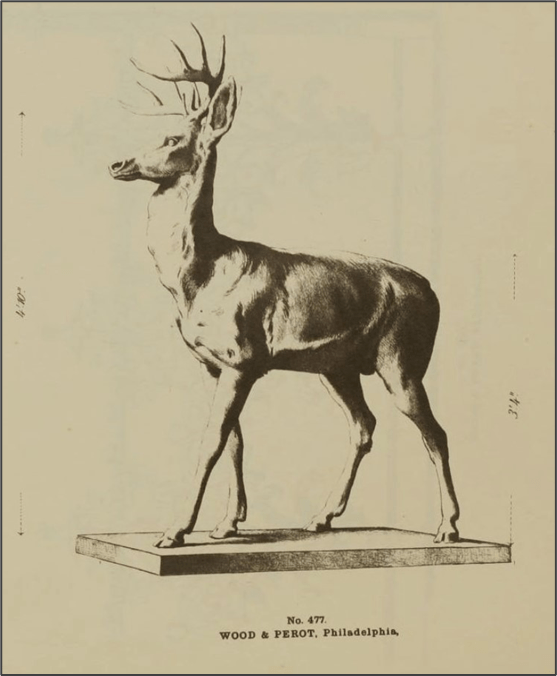
On the Archive.org website, there is a digital copy of an 1876 portfolio/catalog for Robert Wood & Company, and below is the only deer or elk found in it:
Herbie the Elk
Asa Packer—financier of the Lehigh Valley Railroad, state lawmaker, associate judge, member of the U.S. House of Representatives, and the founder of Lehigh University—was said to be the richest man in Pennsylvania at the time of his death in 1879. Packer and his family lived in the town of Jim Thorpe (then called Mauch Chunk) in a mansion, built in 1861, on a hill overlooking the town.
In 1876, Asa Packer was an alternate commissioner for Pennsylvania at the Centennial Exposition, held in Philadelphia. It was at the Expo that Packer himself bought the cast iron statue that now stands on the front lawn of his mansion according to Ava Bretzik, former curator of the Asa Packer Mansion.
Ava also provided the information that the statue is known as an elk, and that he’s called Herbie. She also pointed out that the road in front of the mansion, Packer Hill Avenue, used to be called Elk Street.
As I compared my photos of the Court House Deer and the Google images of the Packer deer to the image in the Robert Wood portfolio, I noticed the measurements in the Robert Wood image—4’ 10” from hoof to top of head and 3’ 4” from hoof to top of back.
It was time for a road trip. What a great excuse—er, reason—to go to Jim Thorpe. My dear hubby, used to my craziness, needed only a little convincing to agree to a road trip that required bringing along a tape measure to measure two cast iron deer that are nearly 40 miles apart.
Our first stop in Jim Thorpe was, of course, the Asa Packer Mansion. We were lucky—it was a clear day, no smoke haze (2023, the summer of the Canadian wildfire smoke). After huffing and puffing a bit while climbing the stairs up the hillside leading to the mansion, I stopped to analyze Herbie, who stands near the top of the steps.
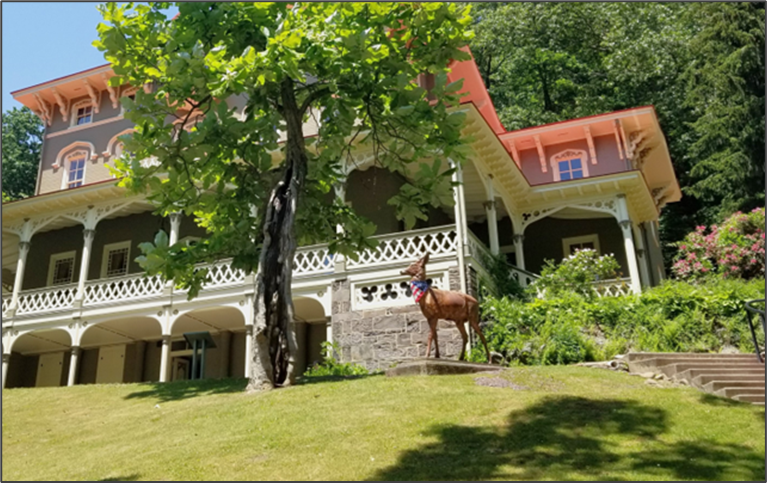
He certainly looks like the Court House Deer I thought as I pulled out my camera for pics, but my husband grabbed my hand and pulled me the rest of the way to the mansion, where we were just in time for a tour.
The Asa Packer Mansion is full of Victorian splendor, from the wall coverings to the stained-glass windows to the lighting to the furnishings. It’s well narrated and well worth going on the tour.
After obtaining permission to take photos of the statue, we went out to the front lawn and approached Herbie. I noticed that he’s missing an antler, and remembered that the Court House Deer, too, had an antler go missing, long since replaced (he complained about it often in Hanson’s articles).
As we examined Herbie a few people looked at us curiously, which isn’t surprising given the multiple photos we took from different angles. It felt as if I was taking booking shots at a police station—from the left, from the right and from the front of our target. “Where were you on the night of…?”
Then my husband pulled out the tape measure and I, my notebook and pen.
“Hoof to top of back?” I called as he measured the distance of the body parts in question.
“Forty-one!”
“Hoof to top of head?”
“Fifty-six and a half!”
My assistance was needed at the other end of the tape measure for chest to rump (43 inches). Photos and measurements in hand, I had what I needed from Herbie for my investigation. With thanks for his cooperation and a pat of his nose, we made our way back down the steps to the car, parked in the lot across from the mansion.
The next day, we drove to Wilkes-Barre to visit the Court House Deer armed with phone, tape measure and notebook.
The poor fellow was made to undergo the same procedure—the perp photos, the indignity of being measured in a very public place (measurements forty, fifty-five and a half, and forty-three).
The Robert Wood & Company’s measurements are 40 inches and 58 inches (no chest to rump, we took that measurement for more data to compare). Taking into account the probable inconsistency of our guesses as to the highest points of backs and heads, and that the Court House Deer’s hooves are set into his base (unlike Herbie’s), the measurements seem close enough, to us anyway, to be able to say that they’re very likely from the same mold.
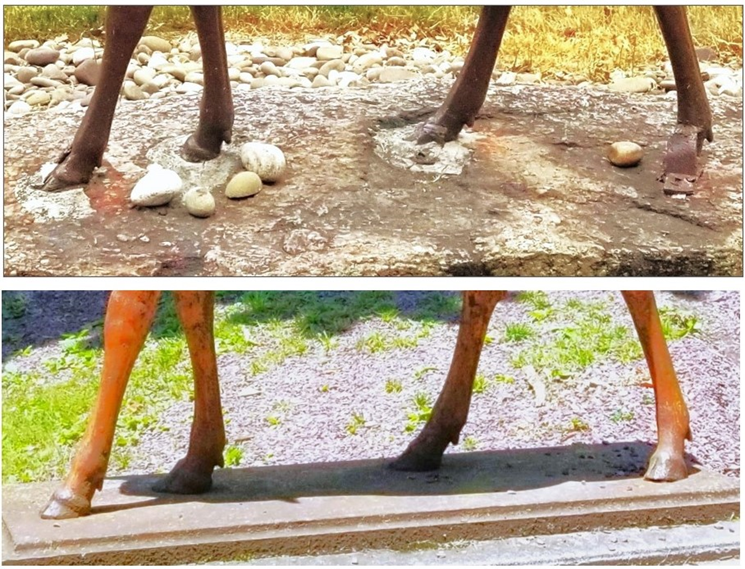
The Court House Deer and Herbie the Elk have similarities in the shape of their antlers, eyes, ears, and nostrils:
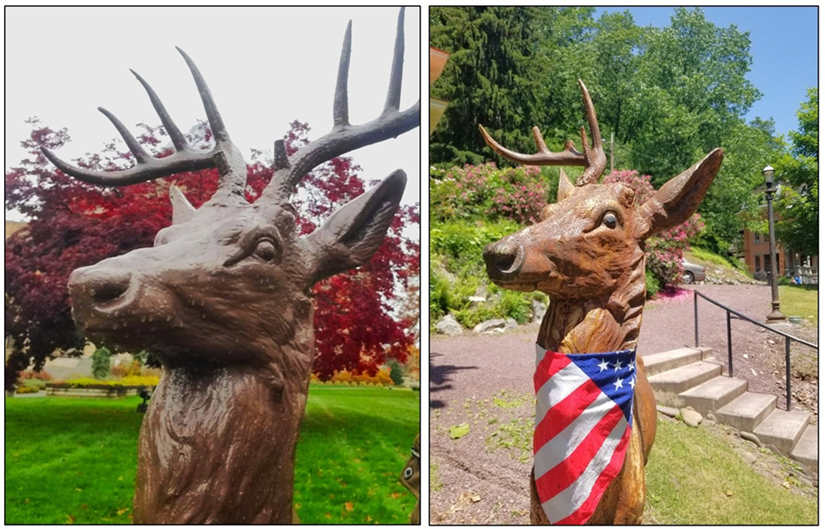
They also have the same sort of ridge around their lower bellies and ruffs of fur at their necks:
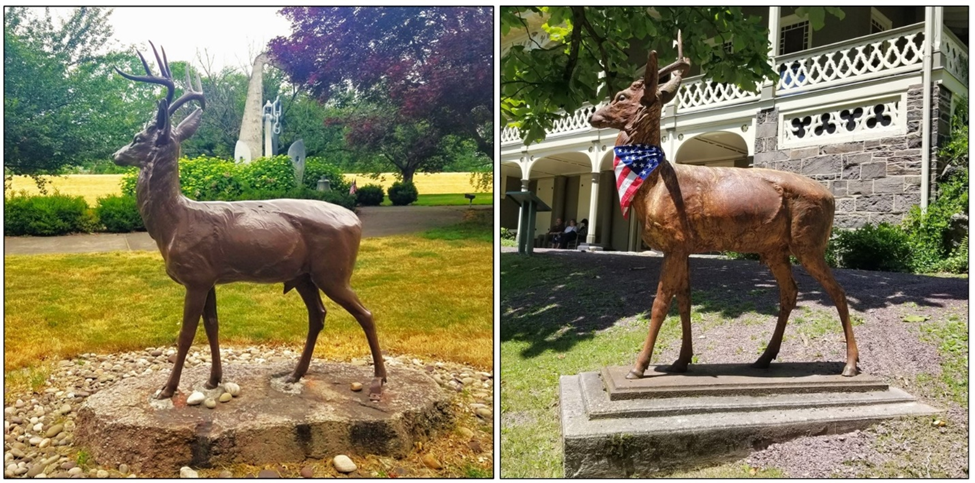
Head direction, hoof placement—also identical.
As I analyzed the data, I was reminded of the courthouse scene in the movie My Cousin Vinny, the one in which Marisa Tomei describes the similarities between two car types: “…the same body length, height, width, weight, wheel base…”
So, are the Court House Deer and Herbie the Elk the same animal? And if so, is the Court House Deer really an elk or is Herbie a deer? The Robert Wood & Co. catalog index identifies their only cervid (hoofed ruminant mammals including deer, elk, and moose) as “statuary,” so there’s no help to be found there.
It doesn’t really matter. Deer or elk, they’re brothers—cast iron cervids from Philly who now live in northeastern Pennsylvania.
And after all they’ve observed from their posts over the years, if the Court House Deer resumed talking or Herbie the Elk decided to start, they would definitely have some fascinating stories to tell.
July 5, 2023: Update–when this article was originally published, Ava Bretzik’s name was mistakenly written as Ava Bretzler, and is now corrected after she graciously pointed out the error.
 ChessieWriter